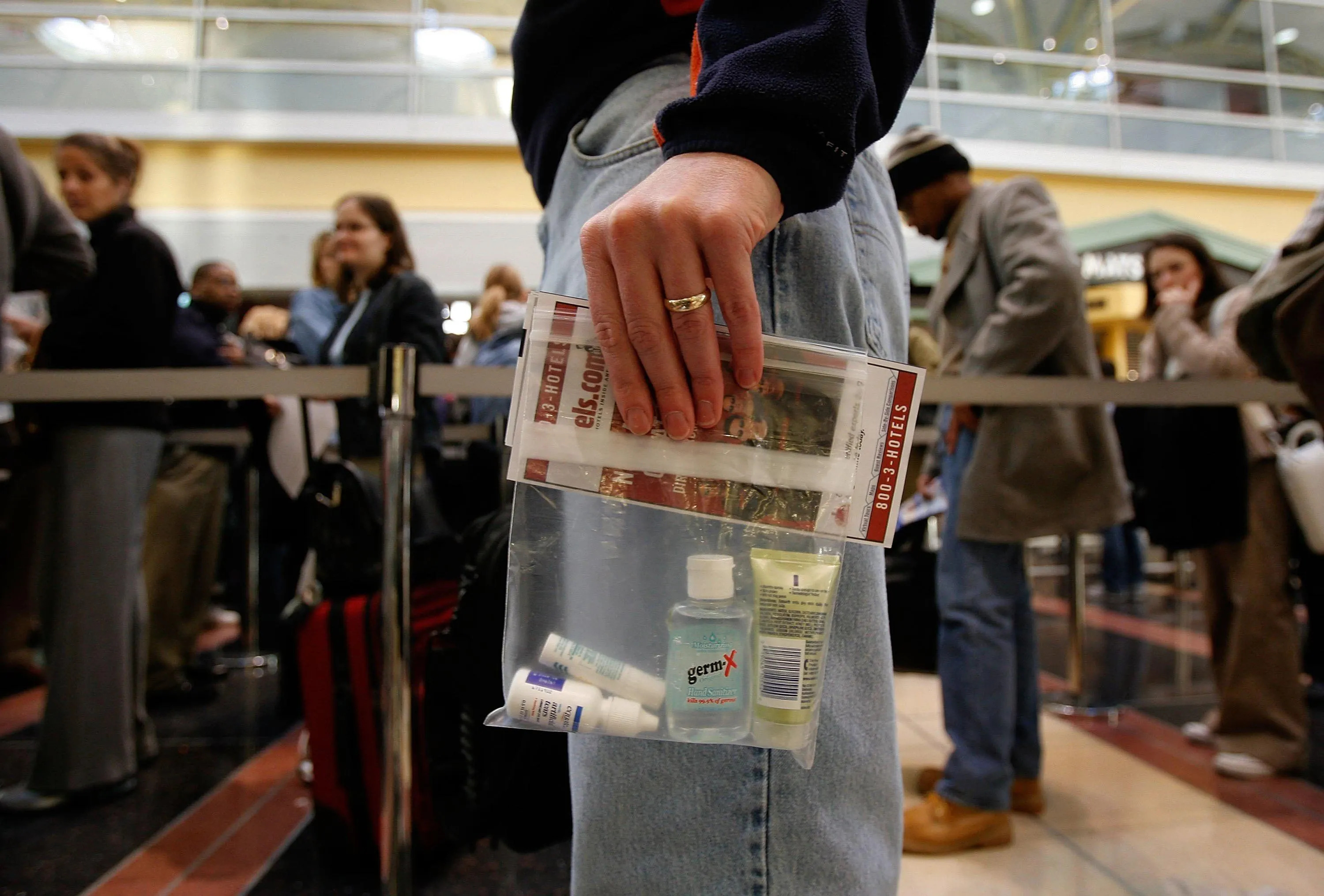
I'll be honest, working out the liquid rules for hand luggage used to just mean memorising "100ml, clear bag, done." Not anymore. A bunch of UK airports have quietly moved the goalposts over the last year, and if you haven't flown recently, you might be packing your bag by rules that don't even apply at your airport anymore. Here's where things actually stand in 2026.
So, What Actually Counts as a Liquid?
First off, what even counts as a liquid? Honestly, more than you'd think. It's not just drinks and shampoo — security treats anything that pours, sprays, smears or spreads as a liquid. So yes, that includes water, wine and juice, but also soup, honey, jam, foundation, mascara, toothpaste, shaving gel, moisturiser, contact lens solution... you get the idea. Peanut butter trips people up constantly because, well, it spreads. Technically a liquid, as far as airport security's concerned.
The 100ml Rule Hasn't Disappeared Everywhere
Now, the 100ml rule. It hasn't gone anywhere at most airports. You still need each container to be 100ml or under, all crammed into a single clear resealable bag no bigger than 20cm x 20cm, capped at one litre total. And in most cases, yes, that bag still comes out of your carry-on for separate screening, unless your airport's upgraded its scanners, which brings me to the next bit.
Which Airports Have Actually Dropped the Limit
Here's the genuinely useful change: some of the busiest UK airports have ditched the 100ml rule completely. New 3D CT scanners can screen liquids properly without you removing anything, so Heathrow (every terminal, T2 through T5), Gatwick, Edinburgh and Birmingham now let you carry containers up to two litres each. No limit on how many, either, as long as none of them go over that. Which, if you're someone who travels with a full skincare routine or hates decanting shampoo into tiny bottles, is honestly a nice bit of news. One thing that hasn't budged though: metal water bottles still need to be bone dry before you go through security, no matter which airport.
A separate batch of airports also has the new scanners installed, so you can leave your liquids and laptop in your bag there too, but the 100ml container cap is still in effect. That list includes Bristol, Leeds Bradford, Luton, Newcastle, Southend, Teesside and Cardiff.
Given how much this varies airport to airport, it's genuinely worth double-checking both ends of your trip before you fly. Don't assume your return airport follows the same rules just because your departure one does.
When You're Allowed to Break the 100ml Rule
There are also a handful of long-running exceptions that let you go over 100ml no matter where you're flying from.
Duty-free is the obvious one. Anything you buy airside or on the plane can go over the limit, so long as it stays sealed in the bag you were given at purchase. Just don't crack it open mid-flight — drinking your own duty-free during the journey isn't allowed, tempting as it might be.
Medication is another. Liquid medicines, eye drops, medical gels — all fine over 100ml, as long as you've got a doctor's letter or prescription on hand. Security might still want to open the container and check it, so don't bury that paperwork at the bottom of your bag.
Lighters get a weird little exception too. You're allowed exactly one, but it has to stay on your person for the whole flight rather than sitting in your hand luggage or hold bag. It still needs the clear plastic bag treatment at the scanner, oddly enough.
Frozen food and ice packs are treated on their own terms. As long as they're solidly frozen, they can go in either hand or hold luggage. The catch is if they've started melting — any liquid pooling at the bottom and security can turn them away.
And then there's baby milk and food, where the rules loosen up considerably. Formula, sterilised water and baby food can be carried in whatever amount you actually need. Unfrozen breast milk is allowed up to two litres, and interestingly, that applies even if you're not travelling with a baby. Frozen breast milk, though, isn't permitted, and sterilised water needs to be in an actual baby bottle with the baby present.
Quick Questions People Keep Asking
Does every UK airport allow liquids over 100ml now?
Nope. It's just Heathrow, Gatwick, Edinburgh and Birmingham that have switched to the two-litre system. Everywhere else, 100ml is still the ceiling, even at airports with the fancier scanners.
Can I bring a 500ml or 1-litre bottle?
Only from those four airports. Anywhere else, it doesn't matter how empty the bottle is — it still needs to be 100ml or smaller.
What about perfume or aftershave?
Same deal — 100ml cap at most airports unless you're flying from Edinburgh or Birmingham, where the two-litre rule covers it.
Deodorant and aerosols?
Yep, treated the same as any other liquid, so the limit depends entirely on which airport you're leaving from.
Can food come through security?
Solid stuff — sandwiches, crisps, fruit — no problem anywhere. It's the runny stuff, soup, houmous, yoghurt, jam, that counts as a liquid and gets capped.
Lighters, vapes, e-cigarettes?
All allowed in hand luggage, never in the hold, because of the battery fire risk. Just remember, one lighter only, and it stays on you rather than in your bag.
One Last Thing Before You Travel
These rules keep shifting as more airports install the new scanners, so it's worth a quick check of both your departure and arrival airports right before you travel. Gov.uk has the most up-to-date guidance. Takes two minutes and could save you an argument at the security tray.
Learn more: How to Find Cheap Flights with Seven Zones Travel